
Part Two — Hip Hop Record Labels
Sugar Hill Records
The New Jersey independent that turned a park jam into a global record business.
- Founded
- 1979
- Founders
- Sylvia Robinson, Joe Robinson and Milton Malden
- Base
- Englewood, New Jersey
- Status
- Defunct 1986; catalog now with Warner Music Group and BMG
Sugar Hill did not invent rap. It invented the rap record as a commercial product — and then proved, twice, that the form could carry both a party and a protest.
Sylvia Robinson's second act
Sylvia Robinson was already a hit singer, songwriter and producer when she and her husband Joe founded Sugar Hill in Englewood, New Jersey in 1979, after Joe folded their previous label All Platinum. Milton Malden was a co-founder; funding came from Tony Riviera and Morris Levy. The name came from Sugar Hill in Harlem, where Sylvia was born.
The idea arrived at a show: after seeing Lovebug Starski perform at Harlem World in 1979, Robinson became convinced that rapping over a groove could be sold on vinyl. With her son Joey Jr., she assembled three MCs — Big Bank Hank, Wonder Mike and Master Gee — into the Sugarhill Gang.
'Rapper's Delight' and the 12-inch economy
In September 1979 Sugar Hill released 'Rapper's Delight' on a 12-inch single, built over the groove of Chic's 'Good Times'. Radio resisted at first, and the label struggled to sell a 12-inch at a time when 7-inch singles set the price expectation. The break came when Sylvia talked WESL St. Louis DJ and programmer Jim Gates into playing it — the station's phone lines jammed with requests.
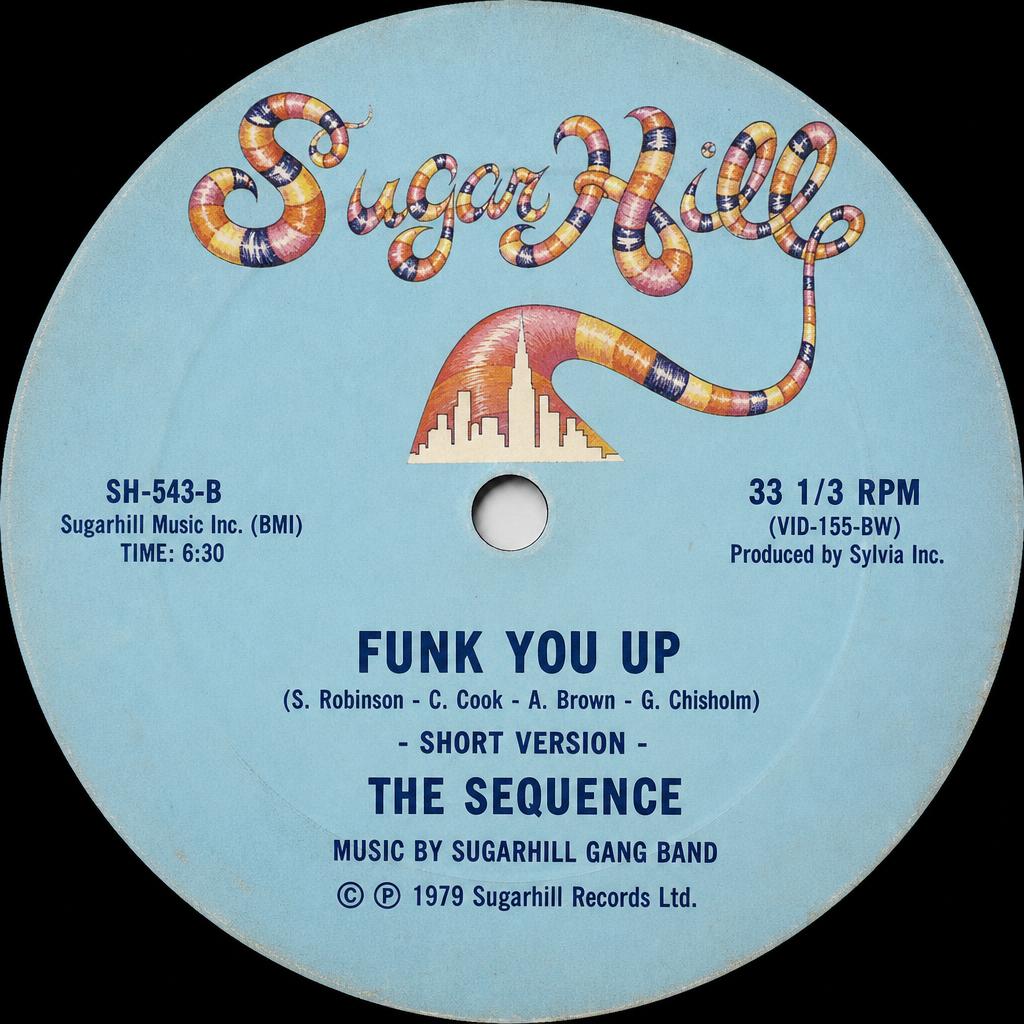
The record reportedly sold some 14 million copies worldwide and made the 12-inch single the native format of hip hop. Right behind it came The Sequence — Angie B., Blondy and Cheryl the Pearl — whose December 1979 debut 'Funk You Up' was the first hip hop record by a female act.
A house band, a roster, and 'The Message'
Sugar Hill's secret weapon was a house band: bassist Doug Wimbish, drummer Keith LeBlanc and guitarist Skip McDonald, who replayed breaks live and gave the label its unmistakable elastic funk. The roster grew to include Grandmaster Flash and the Furious Five, Funky Four Plus One, Crash Crew, Treacherous Three, West Street Mob and Spoonie Gee, and by the early 1980s Sugar Hill was one of the top independent labels in America.
In 1982 the label released 'The Message' by Grandmaster Flash and the Furious Five — the moment rap proved it could report on the conditions that produced it. Distribution troubles, lawsuits and a shifting market caught up with Sugar Hill, and the label folded in 1986, but its catalog is foundational listening.
Essential cuts
1979
Rapper's Delight
The Sugarhill Gang
The record that took rap out of the boroughs and onto world radio.
1979
Funk You Up
The Sequence
First hip hop single by a female group, cut with the house band.
1982
The Message
Grandmaster Flash & the Furious Five
Social realism arrives; the template for conscious rap.
1981
Apache
The Sugarhill Gang
A break-beat standard rebuilt by the Sugar Hill band.
On the roster
- The Sugarhill Gang
- The Sequence
- Grandmaster Flash & the Furious Five
- Funky Four Plus One
- Treacherous Three
- Crash Crew
- West Street Mob
- Spoonie Gee